
Geometry for Digital Fabrication and Architecture
PHD Summer School, DTU, 17–21 August 2026
This summer school is aimed at Master’s and PhD students in mathematics, computer science, architecture, engineering, and related fields.
The school will introduce mathematical and computational methods that arise directly from challenges in architecture and digital fabrication. The main focus will be on simulation, optimization, and geometric rationalization, with particular emphasis on elastic curves and their applications.
Presenters include Christian Müller (TU Wien), Amir Vaxman (U. Edingburgh), Henry Louth (ZHA Architects), Andreas Bærentzen (DTU), Oliver Gross (UCSD), Quentin Becker (U. Tokyo), Konstantinos Gavriil (SINTEF), Rasmus Christiansen (DTU), Camille Schreck (INRIA), Klara Mundilova (EPFL), David Brander (DTU).
Credits: Participation in the full summer school corresponds to approximately 2.5 ECTS points. Participants will receive a certificate of completion, but should negotiate with their home institution if they wish to transfer credit.
 Programme Overview
The school runs Monday through Friday in the week 17-21 August 2026. Location: Auditorium 045 in building 303A. The typical daily programme has a morning session from 08.30-12.00 and afternoon session from 13.30-17.00, except for the minisymposium on Wednesday afternoon, which starts at 13.00.
- Monday 08.30-12.00 Andreas Bærentzen. Surface reconstruction.
- Monday 13.30-17.00 Oliver Gross. 3D elastic curves from multiple perspectives (Part I).
- Tuesday 08.30-12.00 Rasmus Ellebæk Christiansen. An Introduction to Topology Optimization for Computational Design.
- Tuesday 13.30-17.00 Quentin Becker. Elastic rod assemblies (Part I). Wednesday 08.30-12.00 Amir Vaxman. Directional vector fields for meshing in fabrication pipelines.
- Wednesday 13.00-17.00 Minisymposium
- Thursday 08.30-12.00 Oliver Gross. 3D elastic curves from multiple perspectives (Part II).
- Thursday 13.30-17.00 Klara Mundilova. Cone-Nets: Theory, Design, and Fabrication.
- Friday 08.30-12.00 Quentin Becker. Elastic rod assemblies (Part II).
- Fridsay 13.30-17.00 Assembly and measurement of fabricated objects, reflection and evaluation.
 Minicourses
Surface Reconstruction (Monday 08.30-12.00)
Andreas Bærentzen (DTU)
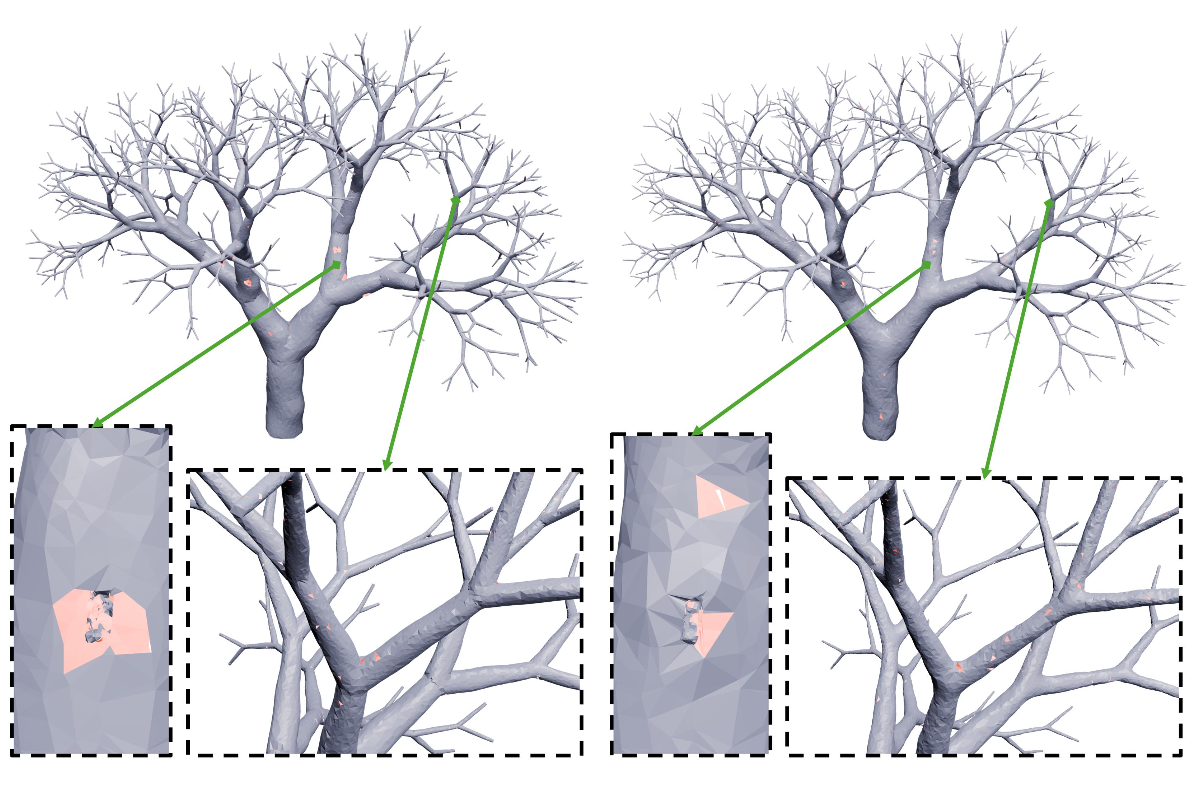
We start with a high-level overview of methods for creating 3D surfaces using optical acquisition, including some recent methods based on machine learning. We move on to focus on the specific problem of reconstructing surfaces from point clouds — regardless of how they are acquired. The mini-course covers both volumetric methods such as the popular Poisson Surface Reconstruction method and combinatorial methods such as our own Rotation System Reconstruction (RsR) method.
A brief introduction to PyGEL and a more general overview of the software used throughout the summer school is provided before the hands-on exercise. In the hands-on part of the course, participants will be able to try out reconstruction from points using both a simple volumetric method which they (partially) implement themselves and the RsR method which is used via the PyGEL library.
3D Elastic Curves from Multiple Perspectives (Mon 13.30-17.00, Thu 08.30-12.00)
Oliver Gross (UCSD)
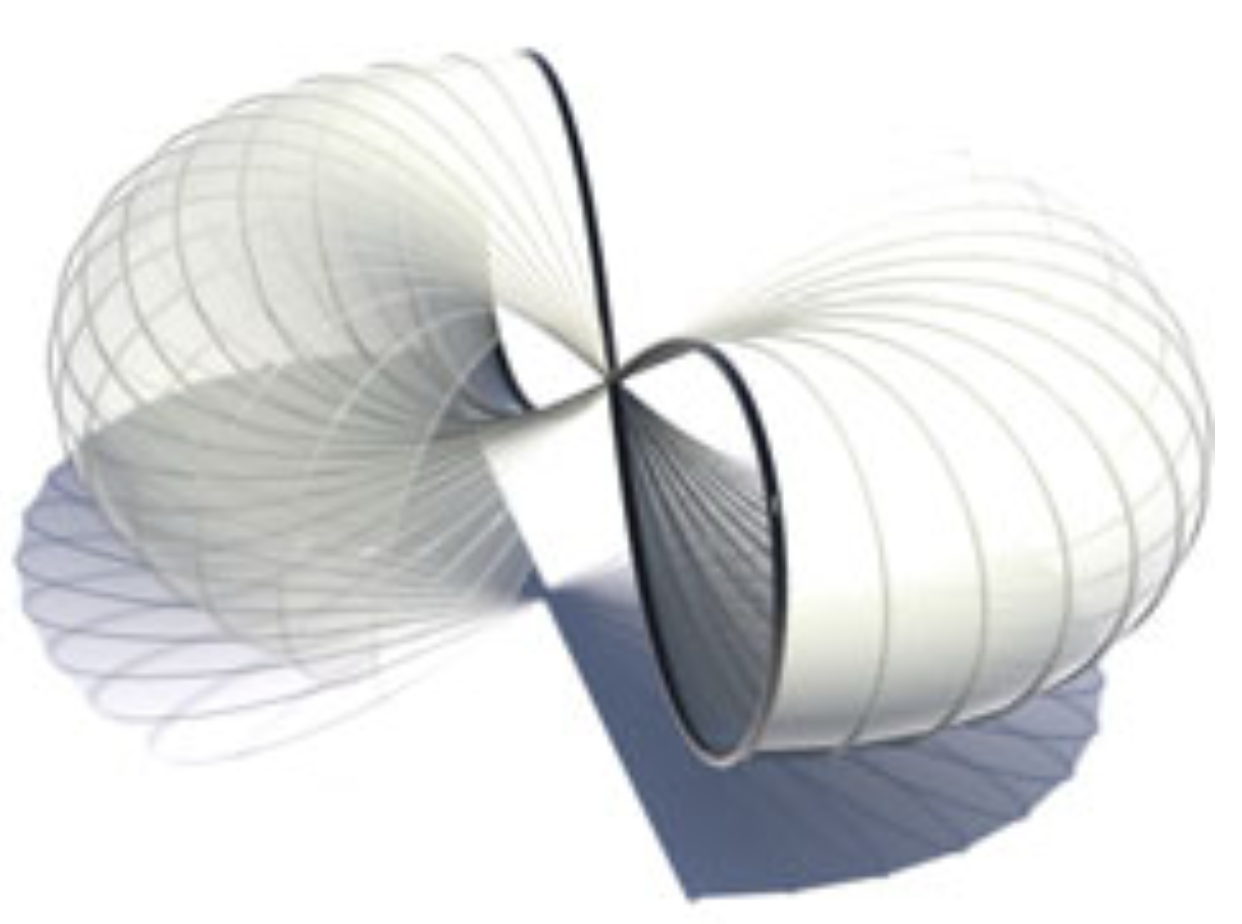
This mini-course will discuss 3D elastic curves through a range of different characterizations. Starting from the classical variational formulation and a brief introduction to the relevant geometric variational principles, we will compare several ways of recognizing elastic curves and discuss how these viewpoints provide useful ways to study and explore them. The goal is to show how continuous theory, geometric structure, and discrete models give different but related perspectives on the same objects. The exercises will give participants a hands-on opportunity to investigate some of the concepts and geometric objects introduced in the lectures.
An Introduction to Topology Optimization for Computational Design (Tue 08.30-12.00)
Rasmus Ellebæk Christiansen (DTU)
This introductory lecture provides a concise overview of topology optimization, a computational design method for determining the optimal distribution of material within a prescribed design domain to achieve specific performance objectives. Participants will be introduced to the fundamental concepts of topology optimization, including the physics problem formulation, objective functions, constraints, and numerical optimization techniques, with an emphasis on applications in structural mechanics. The lecture will present the widely used density-based approach and discuss its numerical implementation using the finite element method. Practical examples from engineering and related disciplines will demonstrate how topology optimization can be used to develop high-performance, lightweight, and resource-efficient designs. The session will also include hands-on exercises that allow participants to explore key concepts and gain practical experience with topology optimization tools and workflows. No prior experience with optimization is required, although familiarity with basic mathematics and computational modeling is beneficial..
Elastic Rod Assemblies: From Geometric Principles to Physics-Based Design Optimization (Tue 13.30-17.00, Fri 08.30-12.00)
Quentin Becker (U. Tokyo)
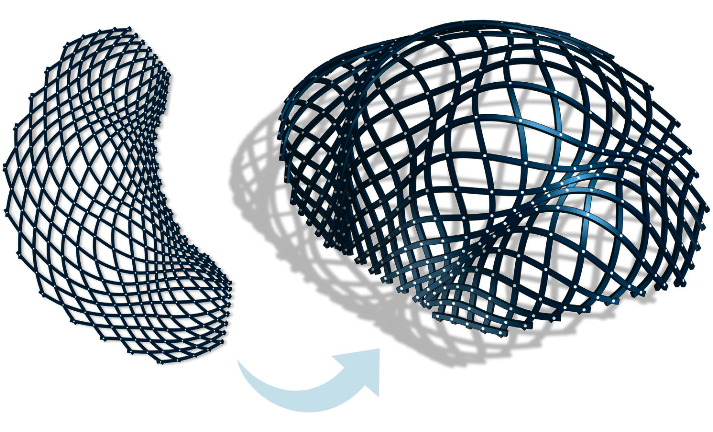
Elastic rod assemblies turn slender, bendable elements into complex curved geometries: bending-active gridshells, umbrella meshes, and woven structures have been realized as pavilions, shading screens, and furniture. Their appeal is partly practical—such structures can be manufactured flat from sheet stock and then deployed or assembled into doubly curved shapes—yet predicting and controlling the resulting form demands both geometric abstraction and accurate physical models.
This mini-course presents the discrete elastic rod (DER) model and its use for both forward simulation and physics-based inverse design of such assemblies. We begin with a geometric perspective, characterizing how isolated lamellae deform and how coupled rod networks exhibit emergent behaviors that can often be interpreted through Gauss–Bonnet-type arguments. We then introduce DER as a discrete elastic energy, cast force-balance equations as variational problems solved with sparse Newton-type methods, and express the deployment through the resulting KKT systems. Building on this, we formulate design optimization as a nested two-stage problem and develop adjoint sensitivity analysis to efficiently differentiate through the forward simulation—the inner problem. Two hands-on Python sessions complement the lectures: participants will implement parts of the DER model, compute equilibria of pinned rods, and explore design through interactive examples.
Directional-Field Methods for Meshing in Fabrication Pipelines (Wed 08.30-12.00)
Amir Vaxman (U. Edinburgh)
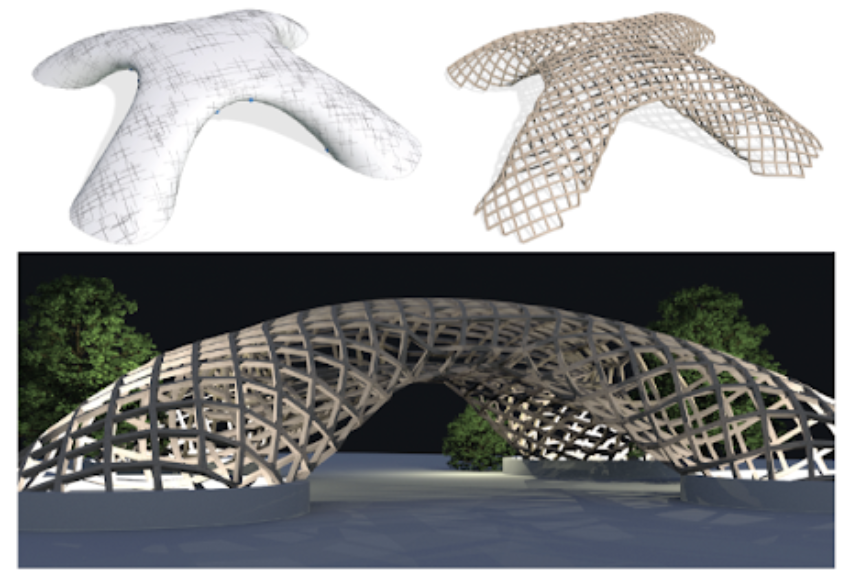
We will explore a classical meshing pipeline that involves defining directional fields on triangle meshes, representing candidate gradients of a parameterization that can be traced into a mesh. This flexible pipeline allows for prescribing diverse objectives and constraints within the meshing process. Building on this framework, we will explore applications such as fabric tessellation, architectural geometry, and physical simulation.
Cone-Nets: Theory, Design, and Fabrication (Thu 13.30-17.00)
Klara Mundilova (EPFL)
Structures made from sheet materials offer practical advantages due to their low fabrication cost and therefore play an important role in architecture, design, and engineering. In this mini-course, we will discuss a class of surface parameterizations known as cone-nets. Their semi-discrete and discrete counterparts form special classes of structures composed of developable strips and regular planar quad meshes, respectively. We will introduce the theoretical background underlying these structures and present a novel construction method, together with its implementation as interactive design tools for Grasshopper/Rhinoceros 3D. We will conclude with an overview of optimization possibilities and fabrication strategies, which students will have the opportunity to explore in practice.
 Minisymposium on Geometry in Digital Fabrication and Architecture
Wednesday 19 August 2026, DTU Building 303A, Auditorium 045
This minisymposium features talks on recent and ongoing research related to the topics of the summer school.
- 13:00 Introduction and Welcome
- 13:10-13:40 Henry Louth (ZHA), Performance Made Visible: Computation, Craft and Architectural Expression
- 13:45-14:30 Christian Mueller (TU Wien) Sphere Meshes in Architectural Geometry
- 14:30-15:00 coffee break
- 15:00-15:45 Camille Schreck (INRIA) StarDEM: a simulation method for designed granular material
- 16:00-16:25 Konstantinos Gavriil (SINTEF) Geometry of Surface Stackability
- 16:30-16:55 David Brander (DTU) Elastic curves and hot-blade cutting
Venue: Building 303A, DTU, Lyngby, Denmark, Auditorium 045.
 Registration
Full Programme: €150. Minisymposium Only: Free
For problems with registration, email: eventsupport@compute.dtu.dk, or one of the organizers listed below. Organizers
David Brander (DTU) — dbra@dtu.dk
Andreas Bærentzen (DTU) — janba@dtu.dk
Konstantinos Gavriil (SINTEF) - Konstantinos.Gavriil@sintef.no